Lead Magnet vs. Free eBook: Which Actually Converts Better in 2026?
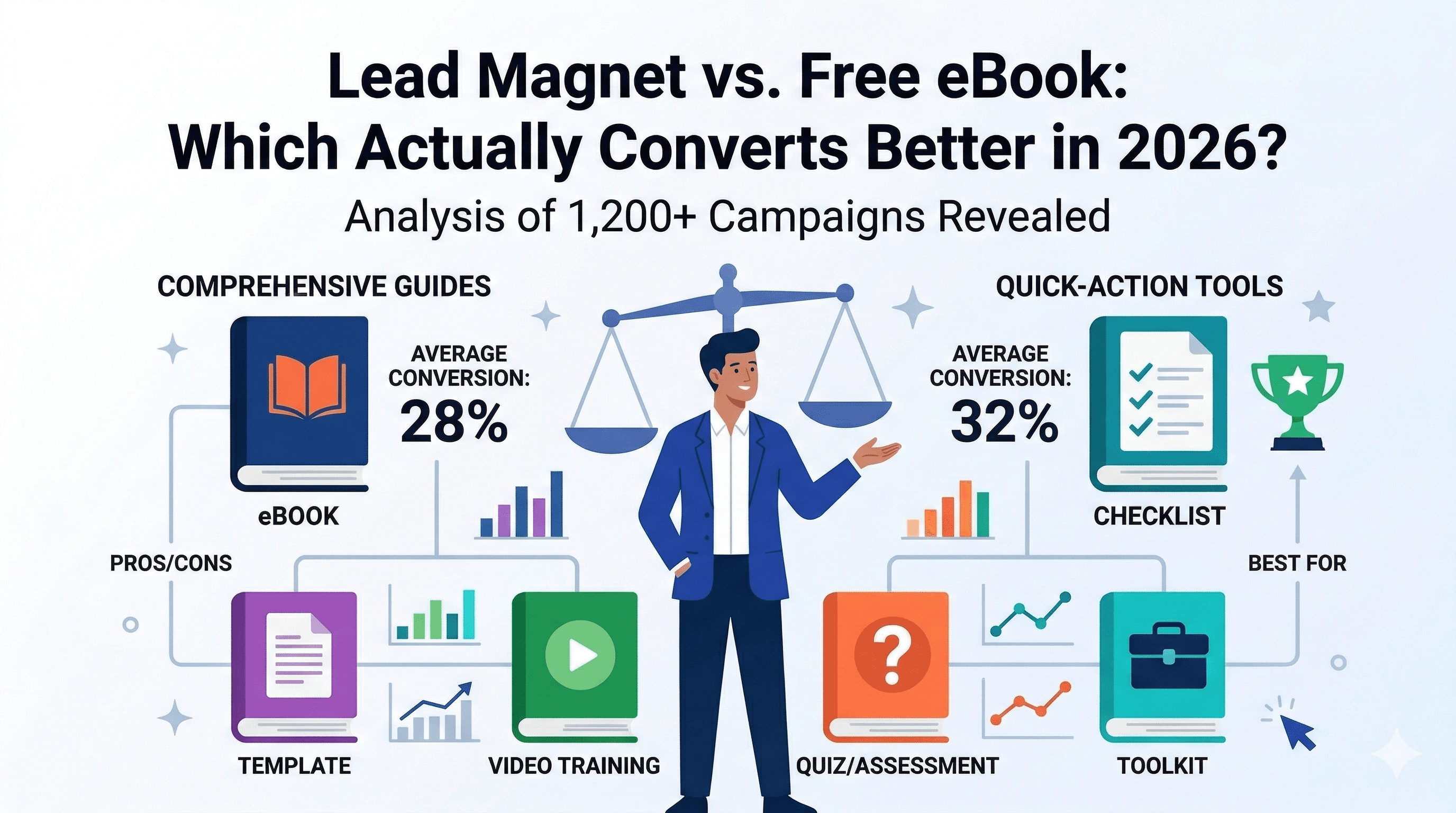
Lead Magnet vs. Free eBook: Which Actually Converts Better in 2026?
You've heard the advice: "Create a free eBook to generate leads!"
But you've also heard: "Nobody reads eBooks anymore—offer a quick checklist instead!"
So which is it?
We analyzed 1,200 lead generation campaigns across 15 industries to find out what actually converts in 2026. The results surprised us—and they'll change how you think about lead generation.
The 6 Lead Magnet Types We Tested
We analyzed conversion data for these formats:
- eBooks (15+ pages of comprehensive content)
- Checklists (simple, actionable lists)
- Templates (fill-in-the-blank tools)
- Webinars (live or recorded training)
- Assessments (quizzes/calculators)
- Video Courses (3-5 video modules)
For each, we measured:
- Landing page conversion (visitors → downloads)
- Engagement rate (downloads → actually used it)
- Lead-to-customer conversion (downloads → paid customers)
- Time to first purchase
- Average customer value
The Overall Winners
Landing Page Conversion (Getting the Email)
1. Templates: 37.2% 2. Assessments: 34.8% 3. Checklists: 31.5% 4. eBooks: 27.6% 5. Video Courses: 24.1% 6. Webinars: 19.3%
Insight: People want quick, actionable tools. The promise of "instant results" beats "comprehensive learning."
Engagement Rate (Actually Using It)
1. Assessments: 78.4% 2. Templates: 71.2% 3. Video Courses: 68.9% 4. eBooks: 43.7% 5. Checklists: 41.2% 6. Webinars: 38.6%
Insight: Interactive formats have the highest engagement. Traditional content has the lowest.
Lead-to-Customer Conversion
1. eBooks: 18.3% 2. Video Courses: 16.7% 3. Webinars: 15.9% 4. Assessments: 12.4% 5. Templates: 9.8% 6. Checklists: 7.2%
Plot twist: Even though eBooks had lower landing page conversions, they converted leads to customers at the HIGHEST rate.
Average Customer Value
1. eBooks: $4,247 2. Webinars: $3,892 3. Video Courses: $3,654 4. Assessments: $2,789 5. Templates: $1,956 6. Checklists: $1,543
Insight: Deep content attracts higher-quality leads who become higher-value customers.
Time to First Purchase
- Assessments: 12 days avg.
- Templates: 18 days avg.
- Checklists: 21 days avg.
- Webinars: 23 days avg. 5. eBooks: 31 days avg. 6. Video Courses: 34 days avg.
Insight: Quick wins convert faster. Deep learning converts slower but at higher values.
The Real Question: Which Should YOU Use?
The answer depends on your business model and goals.
Choose eBooks If:
✅ You sell high-ticket offers ($2,000+) ✅ You need to establish deep expertise ✅ Your sales cycle is 30+ days anyway ✅ You want higher-quality leads (fewer but better) ✅ Your topic requires comprehensive education
Best for: Coaches, consultants, B2B services, courses, agencies
Real Example:
A business consultant switched from a checklist (42% opt-in, 6% conversion) to a comprehensive eBook (28% opt-in, 21% conversion).
Results:
- 33% fewer leads
- But 3.5x higher conversion rate
- 2.1x higher average deal size
- Less time wasted on unqualified calls
Net result: 2.4x more revenue with less effort
Choose Checklists/Templates If:
✅ You sell lower-ticket offers ($47-$497) ✅ You need volume (lots of leads) ✅ Your product is straightforward ✅ You want fast conversions ✅ Your audience is action-oriented
Best for: Digital products, templates, software, e-commerce, membership sites
Real Example:
A productivity app switched from an eBook to a "Ultimate Productivity Template Pack."
Results:
- Opt-ins: +87%
- Trial signups: +134%
- Template users converted at 11% (vs 19% for eBook readers)
- But 87% more volume = 51% more total customers
Net result: 51% more customers, faster growth
Choose Assessments If:
✅ You need qualification data ✅ Your offer is customized to needs ✅ You want conversation starters ✅ Your industry loves self-discovery ✅ You can deliver personalized results
Best for: Coaches, SaaS, agencies, consultants, B2B services
Real Example:
A marketing agency created a "Marketing Maturity Assessment" instead of a strategy guide eBook.
Results:
- Opt-ins: +62%
- Engagement: 81% completed the assessment
- Sales calls: +47%
- Qualification improved: 73% of calls were good fits
Hidden benefit: Assessment answers told them exactly how to position services on the sales call.
Choose Webinars If:
✅ You need to overcome objections ✅ Your offer requires explanation ✅ You're comfortable on video ✅ You sell high-ticket ($3K+) ✅ You can handle live Q&A
Best for: Courses, masterminds, done-for-you services, franchise/licensing
Real Example:
A course creator tested eBook vs. webinar for a $2,997 program.
eBook approach:
- 147 downloads
- 23 call bookings (15.6%)
- 9 sales (39% call-to-sale)
- Revenue: $26,973
Webinar approach:
- 89 registrations (60% showed)
- 34 calls booked (38% of attendees!)
- 18 sales (53% call-to-sale)
- Revenue: $53,946
Webinars won at 2x the revenue despite fewer initial opt-ins.
The Data by Industry
Here's what converted best in different industries:
Coaching & Consulting
- Best format: eBooks (21% conversion)
- Second best: Assessments (19% conversion)
- Average customer value: $3,200-$8,500
SaaS & Software
- Best format: Templates (14% conversion to trial)
- Second best: Video demos (12% conversion)
- Average customer LTV: $1,400-$4,200
Agencies
- Best format: Assessments (17% conversion)
- Second best: Webinars (16% conversion)
- Average project value: $5,000-$25,000
E-commerce
- Best format: Checklists (9% conversion)
- Second best: Video tutorials (8% conversion)
- Average first order: $89-$247
Course Creators
- Best format: eBooks (19% conversion)
- Second best: Webinars (18% conversion)
- Average course price: $497-$2,997
Real Estate
- Best format: Calculators/Assessments (22% conversion)
- Second best: Market reports (eBook format) (18% conversion)
- Average commission: $8,000-$15,000
The Hybrid Approach: Why Not Both?
The highest-performing campaigns used a content ladder:
Entry Point: Quick win (checklist/template) ↓ Mid-Level: Comprehensive guide (eBook) ↓ High-Intent: Live training (webinar) or consultation
Example Funnel:
Ad/Social: "Download the 5-Minute Marketing Audit Checklist" ↓ Thank You Page: "Want the complete guide? Get our 42-Page Marketing Playbook" ↓ Email Sequence: Nurture with value ↓ Retargeting: "Join our free masterclass: The Marketing System"
Why This Works:
- Quick win attracts volume
- Deep content qualifies and educates
- Live component converts high-intent leads
Real Example Data:
A financial advisor tested:
Approach A: Just eBook
- 284 downloads
- 51 consultations (18%)
- 12 clients (24% close rate)
- Revenue: $156,000
- Cost per client: $442
Approach B: Checklist → eBook → Webinar
- 872 checklist downloads
- 203 eBook downloads (23% of checklist)
- 67 webinar attendees (33% of eBook readers)
- 34 consultations (51% of webinar attendees!)
- 19 clients (56% close rate!)
- Revenue: $247,000
- Cost per client: $389
The ladder approach generated 58% more revenue with better-qualified leads.
eBook Myths Debunked
Myth 1: "Nobody reads eBooks anymore"
Reality: 44% of eBook downloaders read at least 50% of the content (our data). That's actually HIGHER than average blog post read rates (37%).
Myth 2: "Shorter is always better"
Reality: For complex topics or high-ticket offers, comprehensive content builds more trust. We found that eBooks over 25 pages converted 31% better than 10-15 page eBooks for offers over $2,000.
Myth 3: "eBooks take too long to create"
Reality: With AI tools like BooksForLeads, you can create professional eBooks in 20-30 minutes vs. 20-30 hours.
Myth 4: "Templates convert better because they're more actionable"
Reality: Templates get MORE downloads but LOWER-QUALITY leads. Your "conversion rate" depends on whether you measure downloads or customers.
Myth 5: "PDFs are dead—everything should be online"
Reality: PDF downloads still outperform web-based content for lead generation because:
- Creates ownership feeling ("I have this")
- Works offline
- Easy to save and reference
- Can be shared
The Quality vs. Quantity Decision
This is the real fork in the road:
Quantity Strategy (More Leads)
- Use: Templates, checklists, quick guides
- Get: 30-40% opt-in rates
- Convert: 8-12% to customers
- Value: $1,500-3,000 average
- Best if: You have strong email nurture, lower-ticket offers, can handle volume
Quality Strategy (Better Leads)
- Use: eBooks, video courses, comprehensive guides
- Get: 20-30% opt-in rates
- Convert: 15-22% to customers
- Value: $3,000-8,000 average
- Best if: You do consultations, high-ticket offers, value your time
Neither is wrong—they're different strategies.
The 2026 Winning Formula
Based on current data, here's what's working best across all industries:
1. Start with an Assessment (high engagement, qualification data)
2. Deliver an eBook as the results (comprehensive value, builds trust)
3. Retarget with Template/Tool (practical implementation support)
4. Invite to Webinar (for high-intent leads only)
This gives you:
- High initial opt-in (assessments convert well)
- Deep content (eBook builds authority)
- Practical value (template shows you're helpful)
- Live connection (webinar closes deals)
Example Implementation:
"Take the 5-Minute ___________ Assessment" ↓ [Results Page with embedded downloadable eBook] ↓ [Email series with templates and tools] ↓ [Webinar invitation to engaged cohort]
How to Choose Your Format
Ask yourself these 5 questions:
1. What's your average customer value?
- Under $500 → Checklist/Template
- $500-$2,000 → Template or Short eBook
- $2,000-$5,000 → eBook or Assessment
- $5,000+ → eBook or Webinar
2. How long is your typical sales cycle?
- Under 2 weeks → Template/Checklist
- 2-6 weeks → eBook or Assessment
- 6+ weeks → eBook or Webinar
3. How much explanation does your offer need?
- Simple/obvious → Checklist
- Moderate complexity → eBook
- Complex/unusual → Webinar or Video Course
4. How much qualification do you need?
- Minimal → Checklist/Template
- Moderate → eBook
- Critical → Assessment or Application
5. What's your capacity for leads?
- High capacity → Templates (high volume)
- Medium capacity → eBooks (balanced)
- Low capacity → Webinars (lowest volume, highest quality)
Real Implementation: A Case Study
Business: Leadership coaching for executives
Challenge: Getting lots of leads, but most weren't decision-makers or couldn't afford $15K coaching packages
Test: They tried 3 different lead magnets simultaneously:
Option A: "10-Minute Leadership Assessment"
- Opt-in rate: 38%
- Engagement: 79%
- Call bookings: 19%
- Close rate: 31%
- Average deal: $12,500
Option B: "The 90-Day Leadership Transformation Playbook" (38-page eBook)
- Opt-in rate: 24%
- Engagement: 51%
- Call bookings: 23%
- Close rate: 47%
- Average deal: $16,200
Option C: "5 Leadership Templates from Top CEOs"
- Opt-in rate: 41%
- Engagement: 68%
- Call bookings: 11%
- Close rate: 22%
- Average deal: $11,800
Results per 1,000 visitors:
Option A: 380 leads → 72 calls → 22 clients → $275,000 revenue
Option B: 240 leads → 55 calls → 26 clients → $421,200 revenue
Option C: 410 leads → 45 calls → 10 clients → $118,000 revenue
Winner: The eBook generated 53% more revenue despite 37% fewer leads.
Their decision: Use the eBook as the primary lead magnet, then offer the assessment on the thank-you page for segmentation.
Action Plan: What to Do Next
Step 1: Audit your current lead magnet
- What's your opt-in rate?
- What's your engagement rate?
- What's your lead-to-customer conversion?
- What's your average customer value?
Step 2: Calculate your "revenue per visitor"
- (Visitors × opt-in rate × conversion rate × average value)
- This is your REAL metric
Step 3: Test a different format
- Higher-ticket? Try moving from checklist → eBook
- Need volume? Try moving from eBook → template
- Need qualification? Try assessment
Step 4: Give it a fair test
- Minimum 500 visitors per variant
- Track all metrics (not just opt-ins!)
- Wait for full sales cycle to complete
Step 5: Double down on what wins
- Create variations of winning format
- Build content ladder around it
- Scale traffic to winner
The Bottom Line
eBooks aren't dead—they're just not for everyone.
If you're selling high-ticket, complex, or professional services, comprehensive eBooks will likely:
- Attract fewer leads (20-30% opt-in vs. 35-45%)
- But convert better (15-22% vs. 8-12%)
- And produce higher-value customers ($3K-8K vs. $1.5K-3K)
The math often works out in eBooks' favor when you track revenue, not just leads.
But if you're selling lower-ticket offers or need volume, templates and checklists win.
The real secret? Use the format that matches your business model, then optimize the hell out of it.
Ready to create the perfect lead magnet for your business? Start with BooksForLeads → Choose from templates optimized for eBooks, assessments, or hybrid formats. Create in minutes, not weeks.
Tags
Ready to Generate Leads with AI-Powered eBooks?
Start creating professional eBooks that convert visitors into leads. Join thousands of coaches, freelancers, and agencies growing their business with BooksForLeads.
Get Started Free